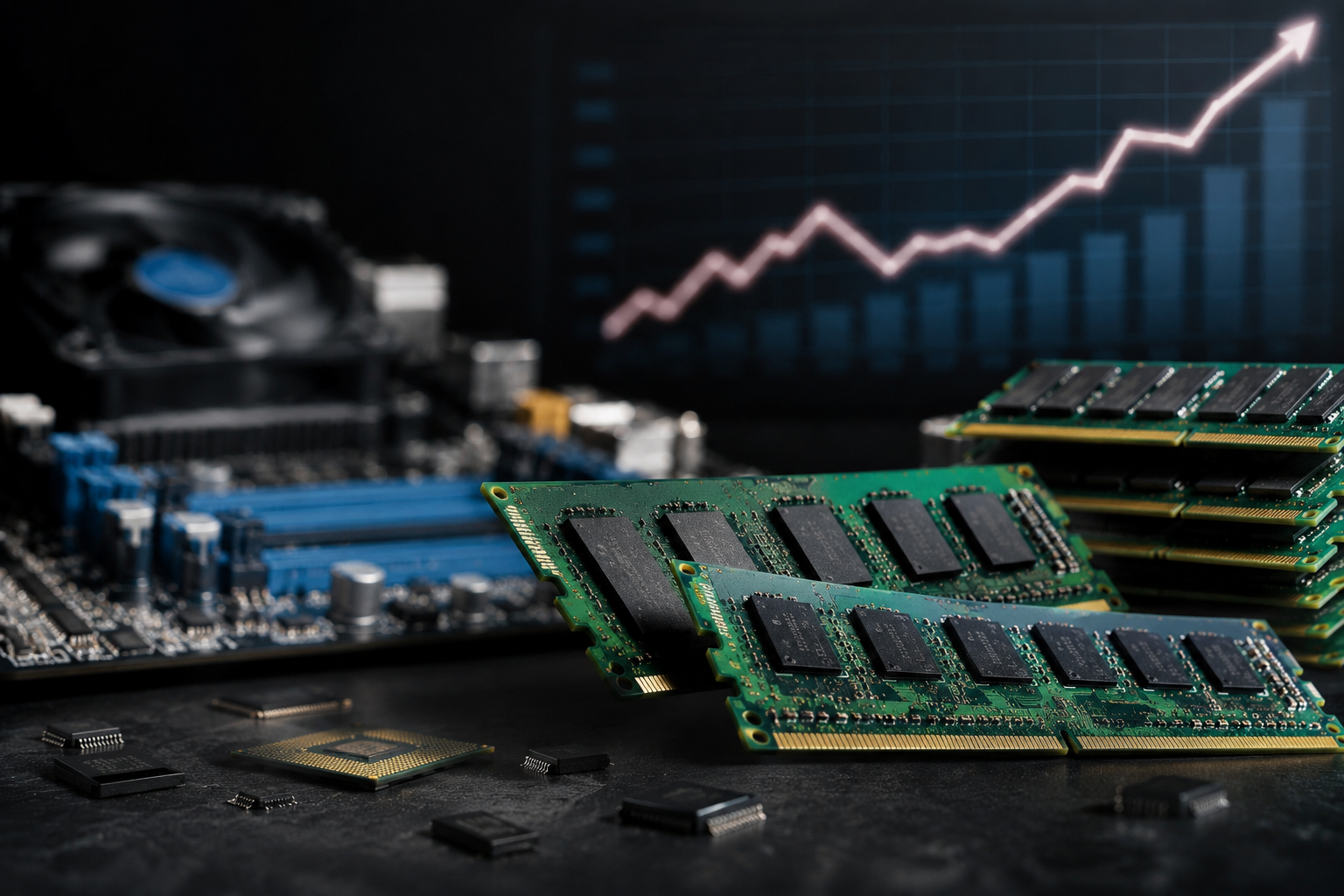
Discover why DDR4 and DDR5 RAM prices are increasing in 2026. Learn how AI servers, memory manufacturers, supply shortages, and growing demand are affecting RAM prices worldwide.
Why Has RAM Become More Expensive? Reasons Behind Rising Memory Prices in 2026
Over the past several months, many computer enthusiasts and PC builders have noticed a significant increase in RAM prices. Both DDR4 and DDR5 memory modules have become more expensive compared to previous years, leaving many consumers wondering what is causing this trend.
The increase in RAM prices is not happening by accident. It is the result of several global factors, including changes in semiconductor manufacturing, the rapid growth of artificial intelligence technologies, shifting production priorities, and rising demand across multiple industries.
If you are planning to build a new PC, upgrade your current system, or purchase a gaming laptop, understanding why RAM prices are increasing can help you make smarter buying decisions.
What Is RAM and Why Is It Important?
RAM (Random Access Memory) is a computer's temporary working memory.
Whenever you launch applications, play games, edit videos, or browse the internet, your system uses RAM to store and process active data.
The amount and speed of RAM directly affect overall system performance.
Today, RAM plays a crucial role in:
Gaming performance
Multitasking
Video editing
Graphic design
3D rendering
Artificial intelligence applications
Virtual machines
Because RAM is one of the most important components in any computer, changes in memory pricing affect millions of users worldwide.
What Has Happened to the RAM Market in Recent Years?
The memory market looked very different in 2022 and 2023.
Following the post-pandemic slowdown in PC demand, memory manufacturers were left with large inventories and excess supply.
As a result:
DDR4 prices dropped significantly
DDR5 became more affordable
Memory manufacturers experienced lower profits
However, market conditions began to change toward the end of 2024.
Manufacturers started reducing production volumes while simultaneously shifting resources toward newer technologies.
These changes eventually led to rising RAM prices throughout 2025 and into 2026.
Who Manufactures RAM?
The global DRAM market is largely controlled by a small number of companies.
The three largest memory manufacturers are:
Samsung
SK Hynix
Micron
Together, these companies produce the majority of the world's DRAM chips.
Their production decisions have a direct impact on memory pricing.
When production decreases, supply becomes more limited and prices tend to rise.
When production increases, prices usually become more stable.
Why Are DDR4 Prices Increasing?
Many consumers expected DDR4 prices to continue falling because the technology is considered older than DDR5.
Surprisingly, the opposite has happened in many cases.
The primary reason is reduced production.
Memory manufacturers are increasingly focusing on DDR5 and advanced server memory products.
As a result:
DDR4 production is declining
Existing inventory levels are shrinking
Demand remains relatively strong
This combination creates upward pressure on DDR4 pricing.
DDR4 is still widely used in older desktop systems, business computers, and enterprise environments, which helps maintain demand even as production decreases.
Why Is DDR5 Becoming More Expensive?
DDR5 has become the standard memory technology for modern computer platforms.
Most current systems based on:
Intel Core Ultra processors
Intel 14th Generation processors
AMD Ryzen 8000 Series
AMD Ryzen AI platforms
are designed around DDR5 memory.
This transition has significantly increased demand for DDR5 modules.
Several factors are contributing to higher DDR5 prices:
Growing adoption of new PC platforms
Rising gaming laptop sales
Increasing popularity of AI-powered computers
Strong demand from the server market
Although DDR5 is far more affordable today than when it first launched, growing demand continues to put pressure on pricing.
How Is Artificial Intelligence Affecting the RAM Market?
Artificial intelligence has become one of the biggest drivers of growth in the technology industry.
The rapid expansion of AI platforms such as ChatGPT, Copilot, Gemini, and other large language models has created enormous demand for data center infrastructure.
These AI systems require massive amounts of memory to process and store data efficiently.
Modern AI servers use dramatically more RAM than traditional computing systems.
Because of this, memory manufacturers are increasingly prioritizing high-margin enterprise and server products.
As more resources are allocated to AI-related hardware, consumer memory markets also experience pricing pressure.
This growing demand from artificial intelligence is now one of the most important factors influencing RAM prices worldwide.
How AI Data Centers Are Driving RAM Prices Higher
Artificial intelligence has become one of the most important forces shaping the technology industry.
Companies such as:
OpenAI
Google
Microsoft
Meta
Amazon
are investing billions of dollars into AI development and data center expansion.
Training and running modern AI models requires enormous computing resources.
As a result, AI servers are equipped with significantly larger amounts of memory than traditional systems.
In some cases, a single AI server may contain:
512 GB RAM
1 TB RAM
2 TB RAM
4 TB RAM
or even more.
This level of demand is changing how memory manufacturers allocate production capacity.
Because enterprise and server memory products generate higher profits, manufacturers increasingly prioritize those markets.
As a result, consumer RAM supply becomes more limited, contributing to higher DDR4 and DDR5 prices.
The Transition from DDR4 to DDR5
Another major factor behind rising RAM prices is the industry's transition to DDR5 technology.
Only a few years ago, DDR4 was the dominant memory standard.
Today, the situation is changing rapidly.
Modern platforms such as:
Intel Core Ultra
Intel 14th Generation
AMD Ryzen 8000 Series
AMD Ryzen AI
are increasingly built around DDR5 memory.
Whenever a new technology becomes mainstream, manufacturers gradually reduce production of older generations.
This creates two market forces simultaneously:
Demand for DDR5 increases
Production of DDR4 decreases
Both trends contribute to price pressure across the memory market.
The Growth of the Gaming Laptop Market
Gaming laptops have become increasingly popular over the last few years.
This growth has also had a noticeable impact on memory demand.
Popular gaming laptop series include:
ASUS TUF Gaming
ASUS ROG
Lenovo Legion
Lenovo LOQ
HP Victus
HP OMEN
MSI Katana
MSI Cyborg
Most modern gaming laptops are now equipped with DDR5 memory.
As gaming laptop sales continue to grow, demand for DDR5 modules increases as well.
Higher demand naturally contributes to rising prices.
The Impact of Major PC Manufacturers
RAM prices are not influenced only by individual consumers.
Large computer manufacturers also play a significant role.
Companies such as:
Dell
HP
Lenovo
ASUS
Acer
purchase millions of memory modules every year for desktops, laptops, and workstations.
When major manufacturers increase their orders, available memory supply becomes tighter.
This often contributes to higher retail prices across the market.
Currency Fluctuations and Logistics Costs
Technology products are heavily influenced by global economic conditions.
Most memory chips are manufactured in:
South Korea
Taiwan
China
Changes in shipping costs, transportation fees, and currency exchange rates can directly affect final product prices.
Even economic events unrelated to technology can impact RAM pricing.
This is one reason why memory prices sometimes increase despite stable production levels.
Will DDR5 Prices Continue to Rise?
This is one of the most frequently asked questions among PC builders and technology enthusiasts.
Many industry analysts believe that DDR5 demand will remain strong throughout the coming years.
Several factors support this outlook:
Continued growth of artificial intelligence
Expanding server infrastructure
Increasing gaming PC sales
Wider adoption of new Intel and AMD platforms
As long as these trends continue, significant price drops are unlikely in the short term.
However, future increases in manufacturing capacity could eventually help stabilize the market.
Should You Buy RAM Now or Wait?
The answer depends on your specific needs.
If you are:
Building a new PC
Buying a gaming laptop
Upgrading your current system
Running out of memory capacity
waiting indefinitely may not be the best strategy.
Current market conditions do not suggest a major decline in RAM prices anytime soon.
In fact, certain memory products could continue to become more expensive if demand remains high.
For users who genuinely need an upgrade, purchasing RAM when needed is often more practical than waiting for uncertain price reductions.
DDR4 vs DDR5: Which One Should You Buy in 2026?
One of the most common questions among PC builders is whether DDR4 or DDR5 is the better choice.
The answer depends on your current platform and future upgrade plans.
If you already own a DDR4-based system and simply want to increase your memory capacity, DDR4 can still be a sensible option.
However, for anyone building a completely new computer, DDR5 is generally the better long-term investment.
DDR5 offers several advantages over DDR4:
Higher memory frequencies
Greater bandwidth
Improved power efficiency
Better support for future platforms
Longer upgrade lifespan
Most modern Intel and AMD platforms are now designed around DDR5 memory.
Because of this, DDR5 is widely considered the preferred choice for new systems in 2026.
What Should You Look for When Buying RAM?
Choosing RAM is about more than simply selecting the lowest price or the largest capacity.
Several important factors should be considered before making a purchase.
Memory Capacity
Different users require different amounts of RAM.
General recommendations for 2026 include:
8 GB – Basic computing tasks
16 GB – Recommended for most users
32 GB – Ideal for gaming and professional workloads
64 GB or more – For advanced professional applications
For new computers, 16 GB should be considered the practical minimum.
Memory Speed
Memory frequency can influence overall system performance.
Popular DDR5 speeds include:
5200 MHz
5600 MHz
6000 MHz
6400 MHz
Higher frequencies can improve performance in certain games and productivity applications.
Dual-Channel Configuration
Using two memory modules typically provides better performance than using a single module.
Examples include:
2×8 GB
2×16 GB
Dual-channel configurations often deliver improved bandwidth and system responsiveness.
Brand Reputation
Reliability is an important factor when choosing memory.
Some of the most trusted RAM manufacturers include:
Kingston
Crucial
Corsair
G.Skill
TeamGroup
ADATA
Well-known brands generally offer better quality control, stability, and warranty support.
What Could Happen to RAM Prices in the Future?
Predicting technology prices with complete accuracy is impossible.
However, current market trends provide valuable insight.
Today, the industry is experiencing:
Rapid AI expansion
Increasing server memory demand
Continued DDR5 adoption
Growing gaming PC sales
Rising demand for high-performance computing
These factors suggest that memory demand is likely to remain strong.
If manufacturers do not significantly increase production, pricing pressure could continue.
On the other hand, larger manufacturing output could eventually help stabilize prices over the long term.
How Do Higher RAM Prices Affect PC Building Costs?
RAM is one of the core components of every computer.
As memory prices increase, the total cost of building a PC rises as well.
This is particularly noticeable in:
Gaming PCs
Workstations
Content creation systems
Rendering machines
Professional productivity setups
Even moderate increases in RAM pricing can noticeably impact the overall system budget.
This is why many PC builders closely monitor memory market trends before making purchasing decisions.
Is Now a Good Time to Buy RAM?
If your current system lacks sufficient memory or if you are building a new PC, delaying a purchase indefinitely may not be beneficial.
Current market conditions show that:
DDR4 production continues to decline
DDR5 demand remains strong
AI infrastructure continues expanding
Server memory demand remains high
None of these factors indicate a significant price collapse in the near future.
For users who genuinely need additional memory, buying RAM when needed is often the most practical approach.
Final Thoughts
The increase in RAM prices during 2026 is the result of multiple global factors working together.
The most significant reasons include:
Growing AI infrastructure
Increased server memory demand
Reduced DDR4 production
Rapid DDR5 adoption
Rising gaming laptop and PC sales
Global logistics and economic factors
The memory market remains one of the most important segments of the technology industry, and changes within it affect both manufacturers and consumers worldwide.
If you are planning to upgrade your computer or build a new system, understanding these trends can help you make smarter purchasing decisions.
For new builds, DDR5 is generally the most future-proof and recommended option.
Frequently Asked Questions
Why has RAM become more expensive?
RAM prices have increased due to higher AI-related demand, growing server infrastructure, reduced DDR4 production, and strong adoption of DDR5 technology.
Is DDR4 still worth buying in 2026?
Yes, especially if you already own a DDR4-compatible system and simply need additional memory.
Will DDR5 prices continue to increase?
Some DDR5 products may continue to rise in price if demand remains strong and supply remains limited.
How much RAM do I need in 2026?
Most users should have at least 16 GB. Gamers and professionals are generally better served with 32 GB.
Does RAM speed matter?
Yes. Higher memory frequencies can improve performance in certain applications and gaming scenarios.
Will RAM prices fall again?
Prices may stabilize in the future as production capacity expands, but significant short-term decreases are not widely expected.
Should I choose DDR4 or DDR5 for a new PC?
For most new systems, DDR5 is the recommended choice because it offers better long-term value and platform support.